
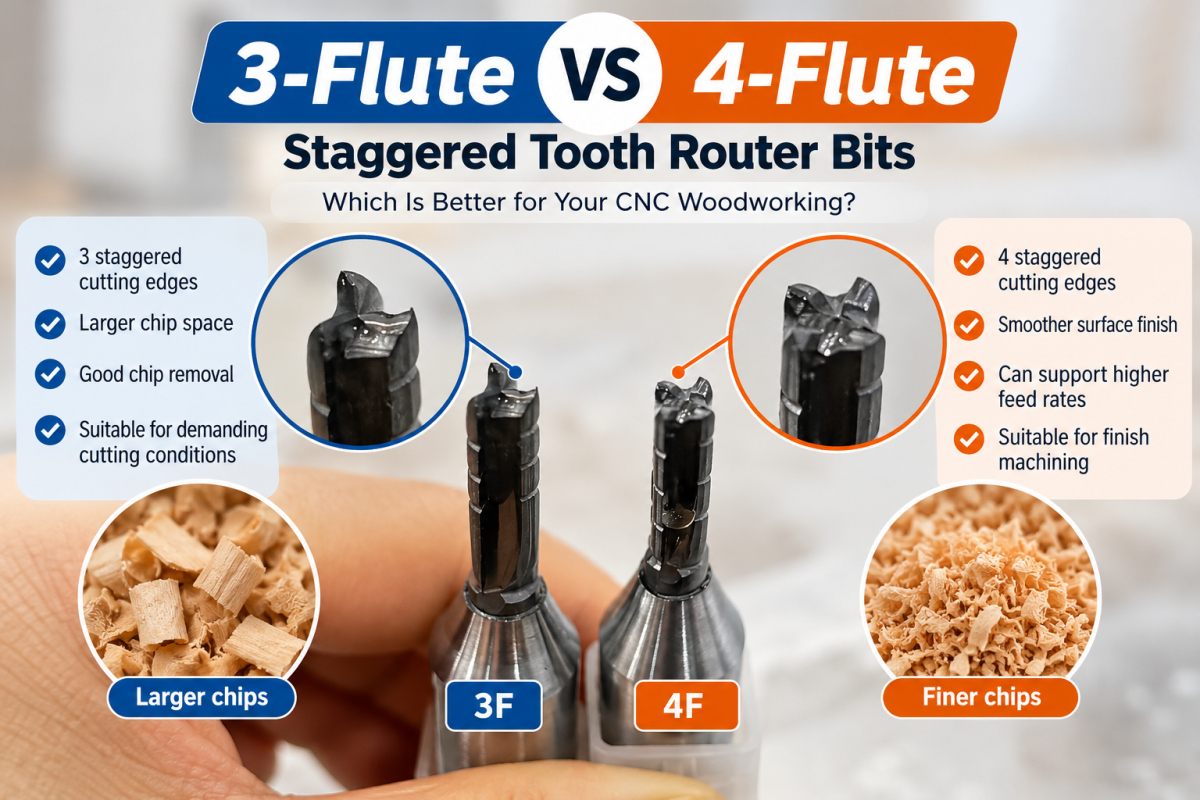
When choosing CNC router bits for woodworking, is a 4-flute cutter always better than a 3-flute cutter?
Not necessarily. More cutting edges do not automatically mean longer tool life.
What’s the Difference Between 3-Flute and 4-Flute Router Bits?
Both 3-flute (3F) and 4-flute (4F) staggered tooth router bits are commonly used for machining wood-based panels, including MDF, plywood, and particleboard.
3-Flute Router Bits:
- Generally provide more chip clearance.
- Can be a practical choice for demanding cutting conditions.
- May offer greater cutting-edge strength in certain cutter designs.
4-Flute Router Bits:
- Provide more cutting edges to distribute the cutting load.
- Can improve surface finish under suitable conditions.
- May support higher feed rates when properly matched with the machine and material.
Does More Flutes Mean Better Durability?
Not always.
Tool life depends on several factors:
- Carbide grade and manufacturing quality
- Cutter diameter and cutting geometry
- Feed rate and spindle speed
- Workpiece material and cutting depth
- Chip evacuation and machine stability
For example, when comparing 3F and 4F cutters with the same diameter, additional cutting edges may reduce the available space for chip removal.
Which Router Bit Should You Choose?
For CNC woodworking applications, the best choice depends on your machine, material, and cutting parameters.
At Leabon Machinery, we help customers select suitable woodworking router bits based on their actual machining requirements.
Contact us with your cutter dimensions and application to find the right solution.

 English
 Español
 العربية
 Русский
 Français
 Português do Brasil
 简体中文