
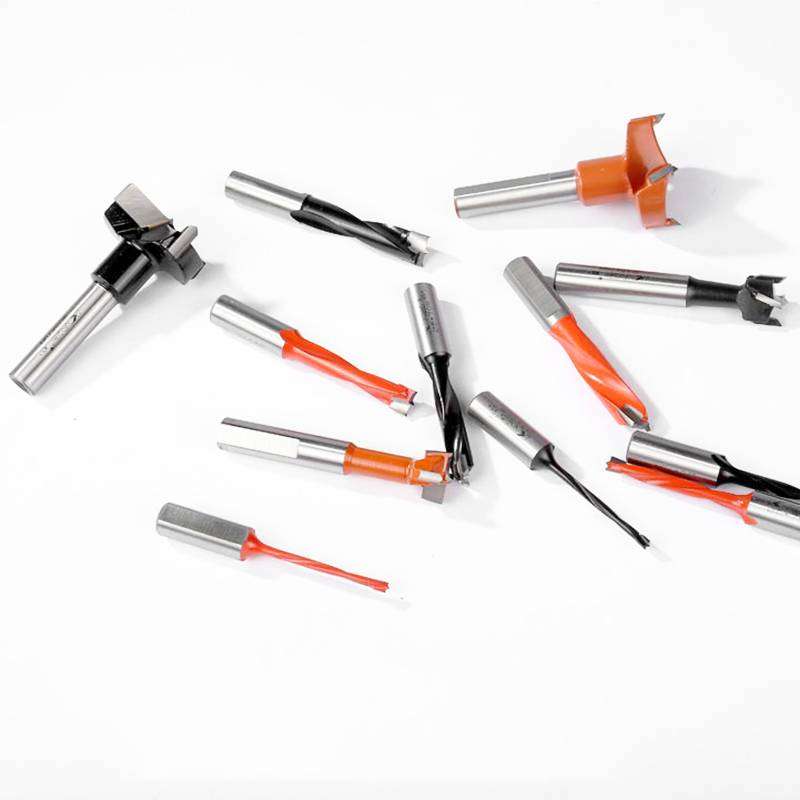
1. Understand the Main Types of CNC Woodworking Drill Bits
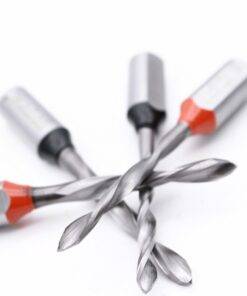
Not all woodworking drill bits are designed for the same application.
The most important starting point is understanding the type of hole you need to produce.
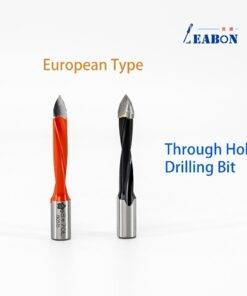
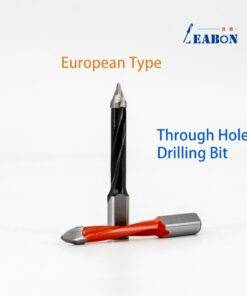
Through-Hole Drill Bits
Through-hole drill bits are designed to drill completely through a panel.
它们常用于:
Dowel holes that pass through the workpiece.
Connector holes.
Panel assembly.
General through-drilling operations in furniture production.
The cutting geometry should be selected according to the material, hole diameter and required exit-face quality.
Some through-hole bit designs use a pointed cutting geometry to help produce cleaner exits, but the correct design depends on the tooling system and application.
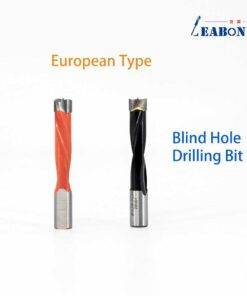
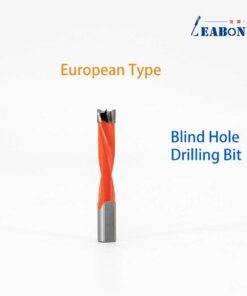
Blind-Hole Drill Bits
Blind-hole drill bits are used when the hole must stop at a specified depth without passing through the panel.
Typical applications include:
Dowel holes.
Furniture connector holes.
Cabinet assembly.
Recessed drilling applications.
The required hole depth and bottom geometry are important when selecting the appropriate bit.
For example, furniture manufacturers producing cabinet panels may require consistent blind-hole depths to ensure accurate component assembly.
Hinge Boring Bits
Hinge boring bits are designed for drilling larger-diameter recesses used for concealed furniture hinges.
They are commonly used in:
Kitchen cabinet doors.
Wardrobe doors.
Furniture door panels.
Cabinet hinge installation.
The most important selection factors include the required hole diameter, depth, cutting geometry and machine compatibility.
Choosing the correct hinge boring bit helps maintain consistent hinge positioning and hole quality during production.
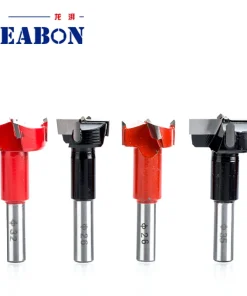
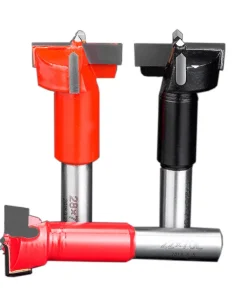
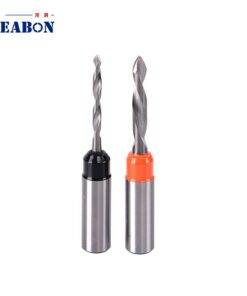
2. Through-Hole vs Blind-Hole vs Hinge Boring: What Is the Difference?
| Drill Bit Type | Main Application | Typical Production Task |
|---|---|---|
| Through-hole bit | Complete holes through panels | Panel drilling |
| Blind-hole bit | Holes with controlled depth | Dowel and connector holes |
| Hinge boring bit | Larger recessed holes | Cabinet hinge installation |
The three types serve different machining purposes.
A furniture factory should select the bit according to the actual hole geometry rather than choosing a drill based only on diameter.
3. How to Choose the Correct Drill Bit Diameter and Working Length
Diameter and working length are two essential specifications when selecting industrial woodworking drill bits.
Drill Bit Diameter
The required diameter depends on the fitting, connector or assembly specification.
Common woodworking drilling diameters include:
3 mm.
5 mm.
6 mm.
8 mm.
10 mm.
12 mm.
15 mm.
These are examples of commonly used sizes, not a universal specification for every furniture factory.
Always confirm the required hole diameter from the furniture design, technical drawing or production specification.
Working Length
Working length determines the available cutting depth.
When selecting a drill bit, distinguish between:
Overall length.
Working length.
Shank length.
Cutting diameter.
A drill bit may have the correct diameter but still be unsuitable if its working length does not match the required drilling depth.
For industrial production, check the tool dimensions against the machine’s tool holder and drilling unit specifications.
4. Choose the Right Drill Bit for MDF, Plywood and Particle Board
Wood-based materials have different structures and machining characteristics.
The correct drill bit should be selected according to the material and required hole quality.
MDF
MDF has a relatively uniform fiber structure but can generate significant dust during machining.
Industrial carbide or TCT woodworking drill bits are commonly used for MDF applications.
Important considerations:
Cutting edge condition.
Chip evacuation.
Hole diameter accuracy.
Tool wear during continuous production.
胶合板
Plywood contains multiple veneer layers with alternating grain directions.
Drilling quality depends on the cutting geometry, tool sharpness and material construction.
Consider:
Veneer tear-out.
Required hole finish.
Panel thickness.
Drilling depth.
Particle Board and Melamine-Faced Panels
Particle board and melamine-faced panels are widely used in furniture and cabinet manufacturing.
When drilling these materials, buyers should consider the surface coating, core structure and required hole quality.
A suitable carbide or TCT drilling tool should be selected according to the machine, material and production requirements.
5. Check Shank Size, Rotation Direction and Machine Compatibility
One of the most common mistakes in purchasing CNC woodworking drill bits is checking the cutting diameter without checking the machine connection.
Before ordering, confirm the following specifications.
| 规格 | What to Check |
|---|---|
| Cutting diameter | Required hole size |
| Overall length | Total tool length |
| Working length | Available drilling depth |
| 柄径 | Compatibility with the holder |
| Rotation direction | Right-hand or left-hand |
| Tool design | Through-hole, blind-hole or hinge boring |
| Machine interface | Collet, drill chuck or drilling spindle |
| 应用 | Material and drilling operation |
Some industrial CNC machines use European-type drilling bits with specific shank and connection dimensions.
Other machines may use different holders or drilling configurations.
Do not assume that a drill bit will fit simply because it has the correct cutting diameter.
Always check the machine manual, tool holder and original tooling specifications before purchasing.
6. Carbide vs TCT Drill Bits: Which Is Better?
Material selection also affects drilling performance and tool replacement costs.
Carbide and TCT are common terms in woodworking tooling, but they do not necessarily describe the same construction.
Solid carbide drill bits are manufactured from carbide material.
TCT drill bits use carbide cutting tips or edges attached to a supporting body.
Both can be suitable for industrial woodworking, depending on the application.
When comparing them, consider:
Material being processed.
Cutting edge geometry.
Required hole quality.
Production volume.
Tool sharpening and replacement requirements.
Total tooling cost over the production cycle.
Rather than selecting a drill bit based only on its material description, evaluate its performance in the actual production application.
7. Common CNC Woodworking Drilling Problems and Their Possible Causes
Even when using the correct drill bit type, production problems can occur.
Here are some common issues to investigate.
Rough Hole Edges
Possible causes include:
Worn or damaged cutting edges.
Unsuitable cutting geometry.
Incorrect machining parameters.
Material characteristics.
Inaccurate Hole Depth
Possible causes include:
Incorrect tool length compensation.
Incorrect depth settings.
Improper tool installation.
Machine calibration issues.
Drill Bit Breakage
Possible causes include:
Incorrect tool selection.
Excessive feed or unsuitable spindle speed.
Poor chip evacuation.
Insufficient tool support.
Incorrect machine setup.
Poor Hole Positioning
Possible causes include:
Workpiece positioning errors.
Incorrect drilling program.
Tool runout.
Machine calibration problems.
When troubleshooting, check the tool, machine setup, workpiece and machining parameters together. Replacing the drill bit alone may not solve the underlying problem.
8. What Information Should You Provide When Purchasing CNC Woodworking Drill Bits?
For furniture manufacturers and woodworking machinery distributors, providing complete specifications helps suppliers recommend suitable products.
Before requesting a quotation, prepare:
| Information | Example |
|---|---|
| Drill bit type | Through-hole / Blind-hole / Hinge boring |
| 直径 | 5 mm / 8 mm / 10 mm |
| Overall length | Actual required length |
| Working length | Required drilling depth |
| 柄径 | Actual holder specification |
| Rotation | Right-hand / Left-hand |
| 材质 | MDF / Plywood / Particle Board |
| Machine brand | HOMAG / Biesse / SCM / Other |
| Machine model | Exact machine model |
| 数量 | Required pieces |
If you are unsure about the drill bit type, send your supplier a photograph of the original tool, machine model or technical drawing.
This information can help narrow down the appropriate product before ordering.
9. Why Source CNC Woodworking Drill Bits from Leabon?
Leabon supplies woodworking drill bits and cutting tools for furniture manufacturing, cabinet production and other woodworking applications.
Our drilling product range includes:
European-type through-hole drill bits.
European-type blind-hole drill bits.
TCT woodworking drill bits.
Hinge boring bits.
Gang drilling tools.
Specialized carbide drilling tools.
We support different drilling requirements and offer product options according to specifications and availability.
Whether you are a furniture manufacturer looking for replacement drilling tools, a cabinet factory purchasing consumables for regular production, or a woodworking machinery distributor sourcing different drill bit sizes, Leabon can help organize your procurement requirements.
You can provide your required dimensions, machine model, original drill bit photographs or technical drawings for product evaluation.
10. Frequently Asked Questions
What is the difference between through-hole and blind-hole drill bits?
Through-hole drill bits create holes that pass completely through the workpiece. Blind-hole drill bits are used for holes that stop at a specified depth without passing through the material.
Which drill bit is suitable for cabinet hinge installation?
A hinge boring bit is commonly used to produce the recessed holes required for concealed cabinet hinges. The diameter and depth should match the hinge specification.
Are CNC woodworking drill bits suitable for MDF and plywood?
Many carbide and TCT woodworking drill bits are designed for MDF, plywood and particle board. The correct design depends on the material, machine and drilling application.
Can I use the same drill bit for different CNC machines?
Not necessarily. Shank diameter, holder type, overall length, rotation direction and machine configuration must be checked before use.
Can I order different drill bit diameters together?
Yes. Mixed-size procurement can be arranged according to product availability and minimum order requirements.
Looking for the Right CNC Woodworking Drill Bits?
Whether you need through-hole bits, blind-hole bits, hinge boring bits or customized drilling tools, Leabon can help you review your requirements.
Send us your drill bit specifications, machine model or product photographs.
Our team will help you identify suitable tooling options for your furniture and cabinet production needs.
Leabon – Your One-Stop Woodworking Accessories Procurement Partner.
与本文相关的配件
- 1 pc Square Hole Saw Mortise Chisel Wood Drill Bit with Twist Drill Square Hole Extended Saw 6mm – 16mm
- 1 Pc Woodworking Drill Holder Drill Row Cross Sleeve Clamp Drill Sleeve Base for Wood Drill Bit on Drilling Rig Collet Chuck
- 1/1.5/2/2.5/3mm Cobalt Coated Twist Drill Bit Set HSS M35 Gun Drill Bit For Wood/Metal Hole Cutter Power Tools 50PCS/Set
- 15mm – 35mm Four Flute Hinge Boring Wood Drill Bit 57mm 70mm Length for Boring Machine to Make MDF Plywood Panel Holes
