
Special-shaped components are the most common customized structural and decorative parts in modern wood furniture manufacturing. Before the widespread application of automatic and CNC machining equipment, furniture factories relied on mature conventional woodworking processes to produce various irregular and profiled furniture parts. Traditional machining features stable operation, low equipment cost and strong adaptability for small-batch furniture production.

1. Planar Straight-Line Special-Shaped Components
Planar straight-line special-shaped components feature customized profiles only on their cross-section with straight overall outlines. Two mature conventional processing methods are widely adopted in the woodworking industry.
The first method uses dedicated profile cutters on a four-sided planer or wood moulder for one-step forming processing. The second method applies fixtures on a spindle moulder (vertical shaper) to complete profile milling, rebating, grooving and edge moulding. This conventional process is simple to operate, highly safe, and capable of stable and consistent machining accuracy, making it suitable for mass production of standard profiled wood parts.
2. Planar Curved Special-Shaped Components
Planar curved special-shaped components refer to flat wood parts with irregular curved outlines. The traditional processing procedure requires workers to draw accurate contour lines on the workpiece surface in advance and fix the workpiece with professional clamps.
According to the longitudinal curve direction of the part, manufacturers select a single cutter head or two counter-rotating cutter heads. With manual feeding and customized mould assistance, curved profile milling is completed on single-spindle or double-spindle moulders.
This traditional process has obvious drawbacks: low operational safety, high labor intensity, low production efficiency and unstable machining precision. For thin workpieces with uniform thickness and minor curvature, auxiliary mould processing on a surface planer is an improved alternative solution.
3. Planar Annular Special-Shaped Components
Planar annular special-shaped components are widely used for furniture decorative frames and circular structural parts. The standard conventional process starts with double-sided planing to ensure flat and smooth panel surfaces.
Workers adopt manual marking or template positioning methods and use an overhead spindle router (upper-axis milling machine) to mill irregular curved profiles on both inner and outer edges of the panel. This processing technology boasts high operational safety, fast processing speed and reliable machining accuracy, which is suitable for batch production of annular furniture accessories.
4. Bent-Structure Special-Shaped Components
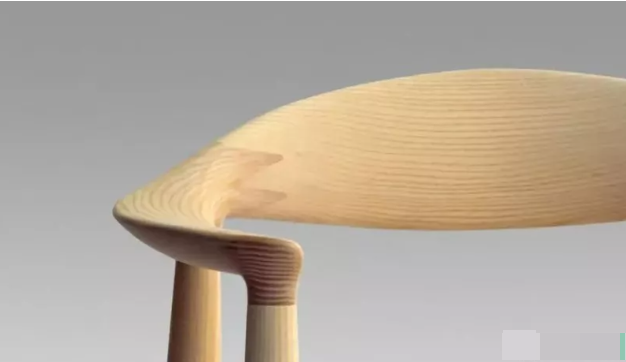
Bent special-shaped furniture components are divided into milled forming parts and bending forming parts according to bending radian characteristics. Milled bent components usually have a bending angle above 100 degrees with gentle arc surfaces.
The conventional processing flow includes blank sawing, curved surface planing and edge profiling on a spindle moulder. However, milling large arc surfaces will cause excessive wood material waste. Meanwhile, cutting off longitudinal wood fibers during milling will weaken the mechanical strength and structural stability of wood components.
Therefore, for high-quality bent furniture parts, integral bending forming technology is more ideal than pure milling processing in actual production.
5. Axisymmetric Special-Shaped Components
Axisymmetric special-shaped components are mostly rotary structural parts, such as furniture columns, decorative spindles and partial rotary carvings. The conventional processing procedure starts with material preparation and four-sided planing to form standard square column blanks.
Workers then complete rotary turning molding on a wood lathe. To enhance surface decoration effects, linear grooves, thread grooves and various decorative textures can be processed by a dedicated fluting machine.
For half-cut or partial axisymmetric special-shaped parts, manufacturers first process complete cylindrical blanks and then perform precise cutting and segmentation. This traditional process is safe, efficient and high-precision, fully meeting the production requirements of decorative furniture structural parts.

 English
 Español
 العربية
 Русский
 Français
 Português do Brasil
 简体中文
简体中文