
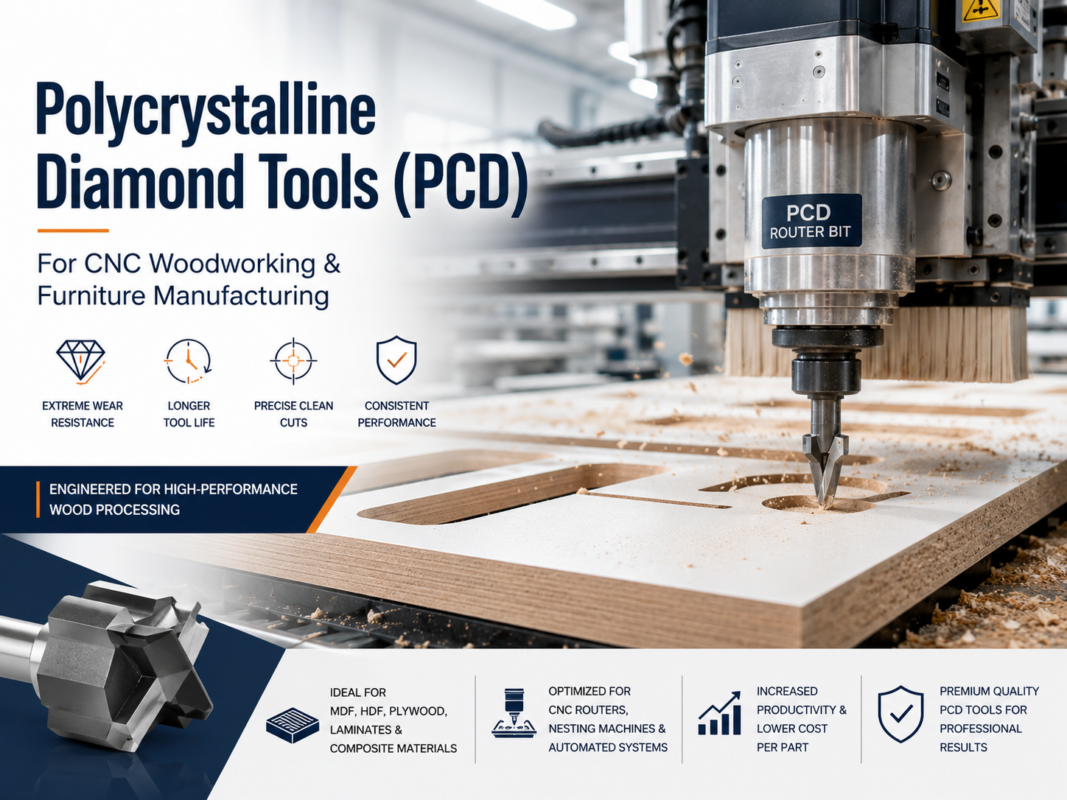
What Is Polycrystalline Diamond (PCD)?
Polycrystalline diamond (PCD) is a synthetic superhard material made by combining diamond particles with a metallic binder under extremely high pressure and high temperature.
Unlike natural diamond, PCD is engineered specifically for industrial cutting applications. It provides excellent hardness, wear resistance, and cutting-edge stability, making it suitable for machining highly abrasive materials.
PCD tools are commonly used in industries including:
- CNC woodworking
- Furniture manufacturing
- Panel processing
- Composite material machining
- Non-ferrous metal machining
For woodworking applications, PCD is especially valuable when machining abrasive materials such as:
- MDF
- Particle board
- HPL laminated panels
- Melamine boards
These materials can quickly reduce the sharpness of standard carbide tools, while PCD maintains a cutting edge for much longer production cycles.
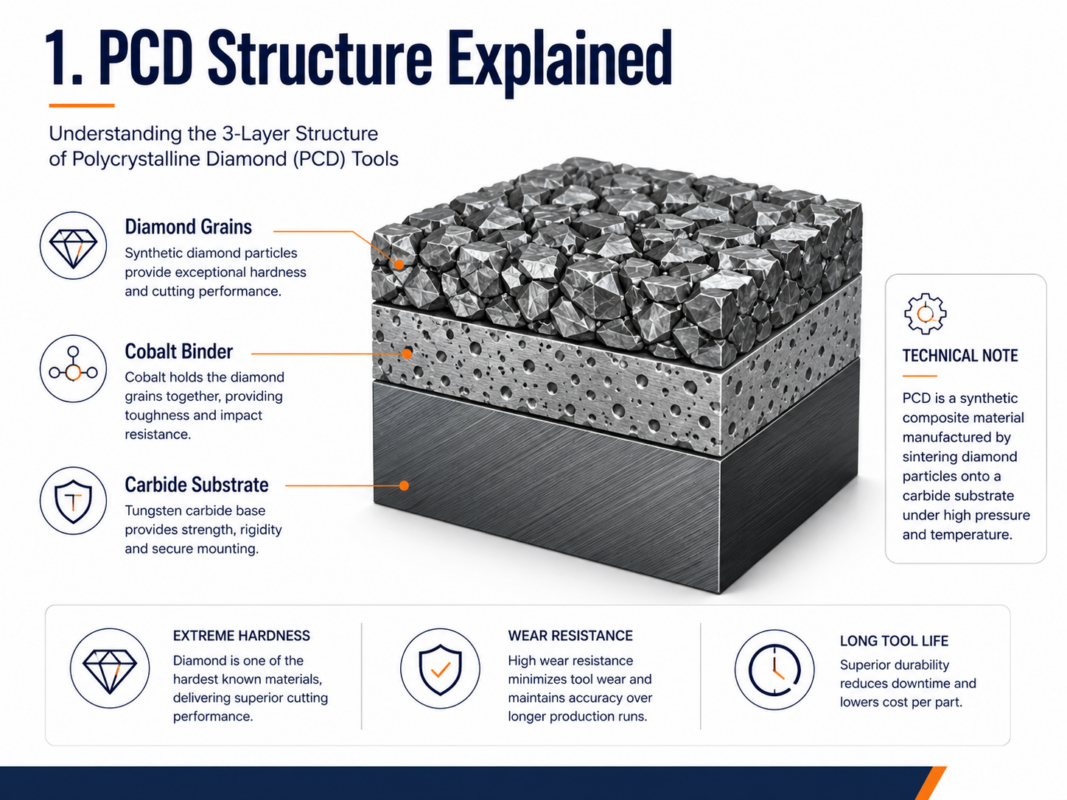
The Structure of PCD Material
PCD is not a solid piece of natural diamond.
Instead, it is a composite structure consisting of three main parts:
1. Synthetic Diamond Grains
Diamond particles provide the extreme hardness and wear resistance of PCD.
These diamond grains are responsible for maintaining the sharp cutting edge during machining.
2. Cobalt Metallic Binder
The cobalt binder connects the diamond particles together and provides toughness.
The balance between diamond content and binder content affects:
- Hardness
- Toughness
- Wear resistance
- Cutting performance
3. Tungsten Carbide Substrate
The carbide substrate supports the PCD layer and allows it to be brazed onto the tool body.
This combination creates a cutting material that is both extremely wear-resistant and mechanically stable.
How Is Polycrystalline Diamond (PCD) Manufactured?
The manufacturing process of PCD tools is more complex than conventional carbide tools.
The performance of a PCD tool depends not only on the diamond material itself but also on the quality of manufacturing, grinding accuracy, and tool design.
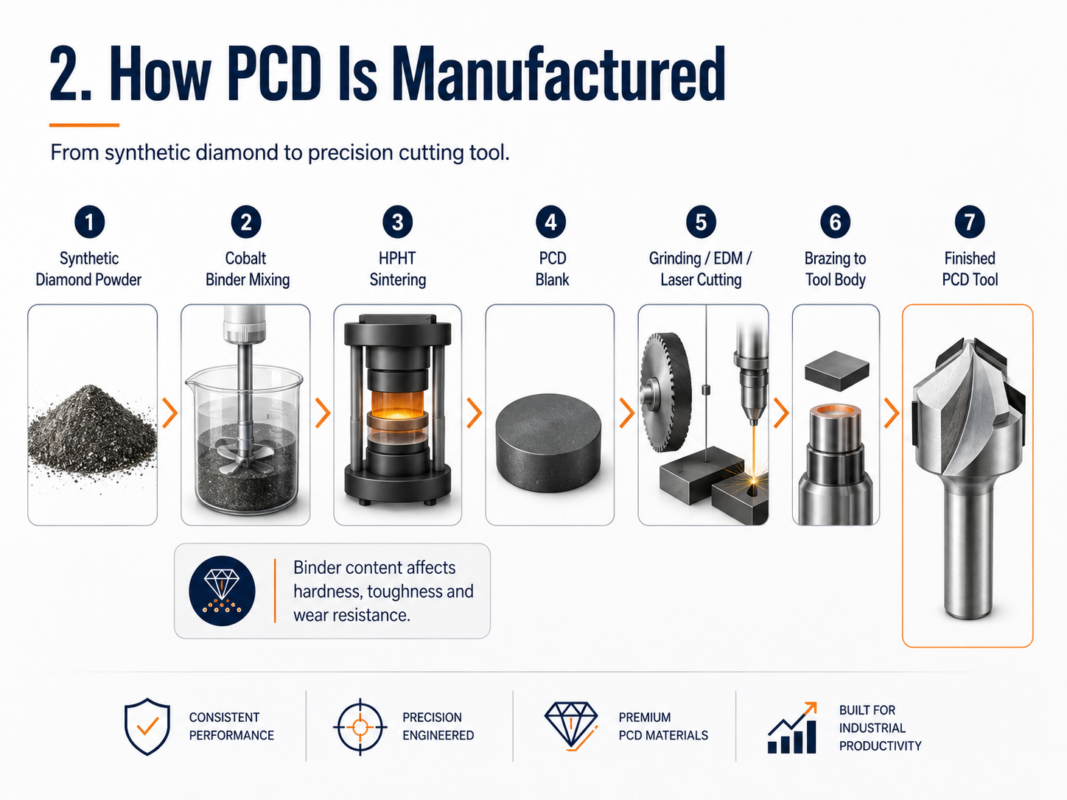
Synthetic Diamond Particles and HPHT Sintering Process
The first step is producing the PCD blank.
Synthetic diamond powder is mixed with a metallic binder, usually cobalt, and then processed under:
- High Pressure
- High Temperature
This process is known as HPHT sintering.
During sintering, diamond particles bond together and form a dense polycrystalline structure.
The final characteristics of the PCD blank depend on:
- Diamond grain size
- Diamond concentration
- Binder composition
- Sintering conditions
A higher diamond concentration usually improves wear resistance, while the binder affects toughness and impact resistance.
Cutting and Shaping PCD Blanks Into Tools
After the PCD blank is produced, it must be shaped into the final cutting tool.
Common processes include:
Diamond Grinding
Diamond grinding wheels are used because ordinary abrasives cannot effectively machine PCD.
This process creates the required:
- Cutting angle
- Edge geometry
- Surface finish
EDM Machining
Electrical discharge machining (EDM) can be used for precise shaping of PCD components.
It is especially useful for complex geometries and fine cutting edges.
Laser Cutting
Laser technology allows manufacturers to create accurate shapes and profiles for specialized PCD tools.
Brazing
The finished PCD cutting tip is brazed onto a carbide body or tool base.
High-quality brazing is essential because the connection between the PCD layer and tool body directly affects reliability during high-speed machining.
Why Manufacturing Quality Matters for PCD Tools
Not all PCD tools provide the same performance.
Two tools may use the same PCD material but have completely different service life because of differences in:
- Cutting edge preparation
- Tool geometry
- Brazing quality
- Balance accuracy
- Manufacturing tolerance
For CNC woodworking applications, precision is especially important because even small differences can affect:
- Surface finish
- Edge quality
- Tool vibration
- Machine stability
A high-quality PCD tool is not only about using diamond material. It is about combining the correct material, design, and manufacturing process.

 English
 Español
 العربية
 Русский
 Français
 Português do Brasil
 简体中文
简体中文