
A spiral (helical) cutter head and a traditional straight knife both slice wood, but they do it very differently. Choosing the right one changes your surface finish, your noise level, and how often you touch a wrench. This guide compares them head-to-head so you can pick with confidence. How Each Cutter Head Works A straight-knife […]
Category Archives: Woodworking Accessories Tips
Tips for select and use of woodworking accessories and tools.
A carbide insert mainly includes a tungsten-cobalt carbide substrate and a functional surface coating. The tungsten-cobalt substrate itself offers high hardness to complete various cutting operations. Additional surface coatings are applied to further improve cutting performance and extend tool service life. Without changing the carbide base material, coatings bring obvious performance improvements. Therefore, coated carbide […]
Woodworking Accessories Tips
PCD Grades and Grain Size Explained: How to Choose the Right PCD Tool for Woodworking
22
Aug
Aug
Not all polycrystalline diamond tools have the same cutting performance.
Although every PCD tool uses synthetic diamond particles as the cutting material, the size of diamond grains and the bonding structure inside the PCD layer can significantly affect:
Cutting edge sharpness
Wear resistance
Impact resistance
Surface finish quality
Tool life during CNC machining
For woodworking applications, choosing the correct PCD grade is especially important because different materials create different levels of cutting stress.
For example:
Laminated panels require a sharper cutting edge to reduce chipping.
MDF and particleboard require excellent wear resistance because of resin and abrasive fillers.
Heavy material removal requires stronger PCD grades that can withstand higher cutting forces.
Choosing the wrong PCD grade may lead to premature edge damage, poor surface quality, or unnecessary production costs.
Woodworking Accessories Tips
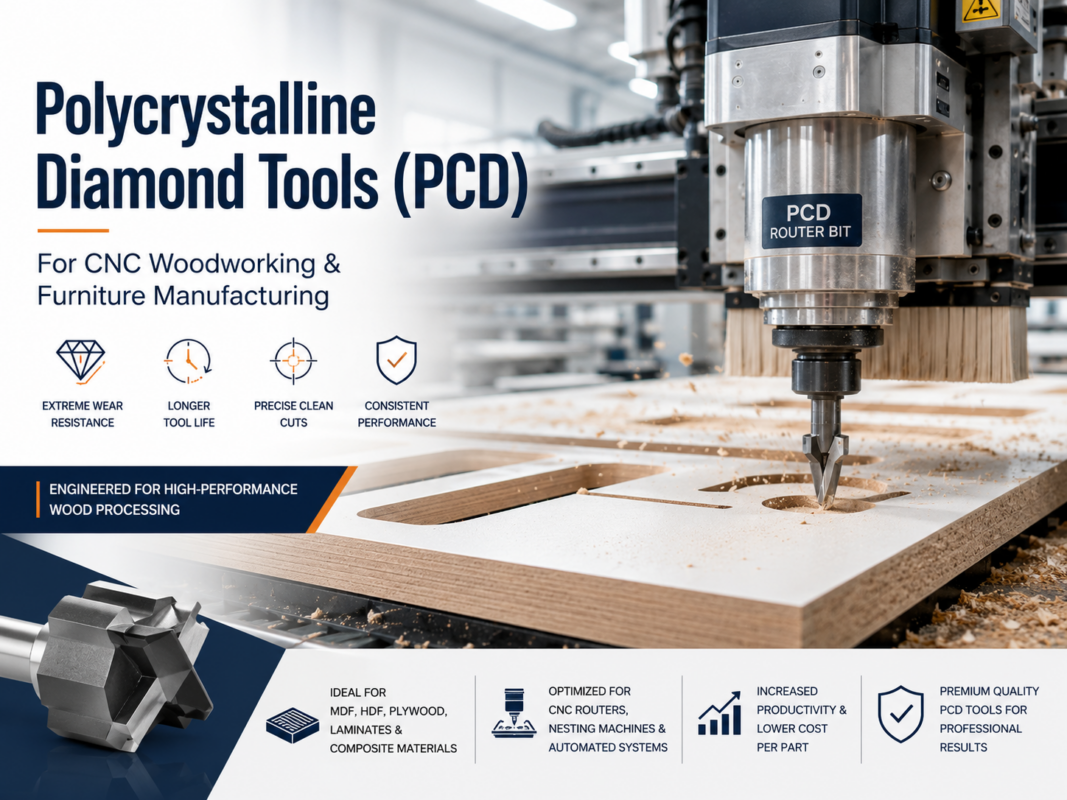
Polycrystalline Diamond Tools (PCD): Complete Guide for CNC Woodworking and Furniture Manufacturing
27
Jul
Jul
Polycrystalline diamond tools (PCD) have become one of the most reliable cutting solutions for high-volume CNC woodworking and furniture manufacturing.
In modern woodworking production, materials such as MDF, particle board, HPL, and laminated panels are widely used because they provide stable quality and cost advantages. However, these materials also contain abrasive components such as resin, glue, and fillers, which can quickly wear conventional carbide cutting tools.
Frequent tool replacement does not only increase tooling costs but also causes machine downtime, inconsistent cutting quality, and higher production waste.
This is why many CNC woodworking factories are choosing PCD tools for applications where long tool life and stable cutting performance are critical.
This complete guide explains what polycrystalline diamond tools are, how they are manufactured, why PCD performs differently from carbide tools, which materials are suitable for PCD machining, and how to choose the right PCD tool for your production needs.
Question I want to machine clean, smooth internal fillet radius surfaces. When machining tiny fillet radii inside deep cavities, the cutting tool suffers severe chatter vibration. What operations can I adopt to get flawless internal fillet finish? Key Point: Proper Cutting Edge Diameter Selection If you use a flat end mill with the identical radius […]
Choosing a drill bit for wood sounds simple until you see how many different options are available.
Brad point bits, twist bits, auger bits, spade bits, Forstner bits, and hole saws may all drill wood, but they do not produce the same type of hole.
Using the wrong bit can cause rough edges, tear-out, burn marks, inaccurate holes, or even a damaged workpiece. The right bit, however, makes drilling cleaner, faster, and easier.
So, how do you choose the right drill bit for wood?
Start with five questions:
What type of hole do you need?
What material are you drilling?
How wide and deep is the hole?
How clean must the finished hole be?
What drill or woodworking machine are you using?
This guide explains the main types of wood drill bits, their best uses, materials, drilling tips, and common mistakes to avoid.
Uneven glue lines, melamine chip-out, rough edge finishes, burr defects, and frequent unexpected machine downtime are the most common quality and productivity pain points in industrial woodworking edgebanding production. Most furniture factory owners and workshop operators wrongly attribute these edge defects to low-quality edgebanding cutter brands. However, real-world wood manufacturing experience fully proves that poor […]
Woodworking Accessories Tips
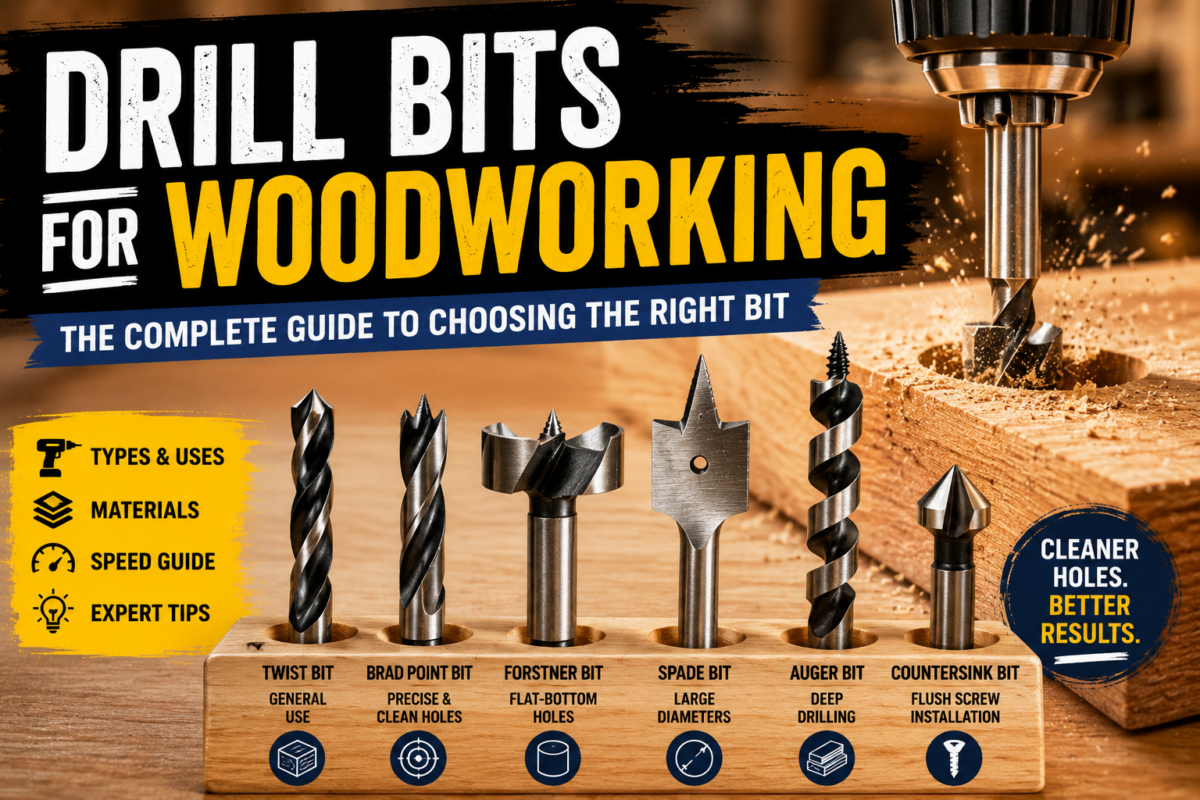
Drill Bits for Woodworking: The Complete Guide to Choosing the Right Wood Drill Bit
30
May
May
If you’ve ever walked into a hardware store or searched online for drill bits for woodworking, you’ve probably noticed there are dozens of different options available.
Twist drill bits, brad point bits, Forstner bits, spade bits, auger bits, countersink bits—the list goes on.
So how do you know which woodworking drill bit is right for your project?
Choosing the wrong drill bit can lead to rough holes, tear-out, burning, inaccurate drilling, and even damaged workpieces. On the other hand, using the correct wood drill bit will give you cleaner holes, faster drilling, and professional-looking results.
In this guide, we’ll explain the different types of drill bits for woodworking, their applications, materials, drilling speeds, and expert tips to help you choose the right bit for every woodworking project.
When it comes to woodworking or CNC machining, selecting the right router bit can make or break your project. Two of the most common options are High-Speed Steel (HSS) bits and Carbide-tipped bits. While both can cut wood and other materials, they differ significantly in durability, finish quality, heat resistance, and cost. If you’ve been wondering “carbide vs hss router bits: which is better?”, this comprehensive guide breaks it down in detail.
“Silent saw blade” or “quiet saw blade” is a common marketing term in cutting tool industry. Experienced workers know fully silent blades cannot exist with current technology. This goal may come true with future technical upgrades. Noise is inevitable once a saw blade cuts materials. Different blades also produce different sounds. Aluminum cutting creates sharp […]
 English
 Español
 العربية
 Русский
 Français
 Português do Brasil
 简体中文